
Our Voices
John the Educators Rising Rapid Response Survey team
Do you want your voice heard on the most significant issues in education? Becoming a Rapid Response Survey team member is an incredible way to share your student voice. It’s easy! Sign up online, and we’ll text you when a new survey is ready. Each survey takes just a few minutes, but your responses can make a real impact on educational policy. As a reward, each team member gets a $5 discount code for the Educators Rising Store, valid for one month.
Don’t miss this chance to be part of something bigger. Let’s reach our goal of 500 participants together! Sign up using an online application form.
Rising, Rising Voices
Educators Rising this year is launching Rising Voices, an online blog that is written expressly for our students and teacher leaders. In addition to content provided by our Kappan team, we look forward to publishing shortform content from students and teacher leaders that highlights what’s happening in your communities. Whether you like to express yourself through the written word, or video, or through visual art, we are currently accepting content.
If you’re thinking of contributing, we invite you to join our RisingVoices mailing list to get updates and to learn more about how to contribute.
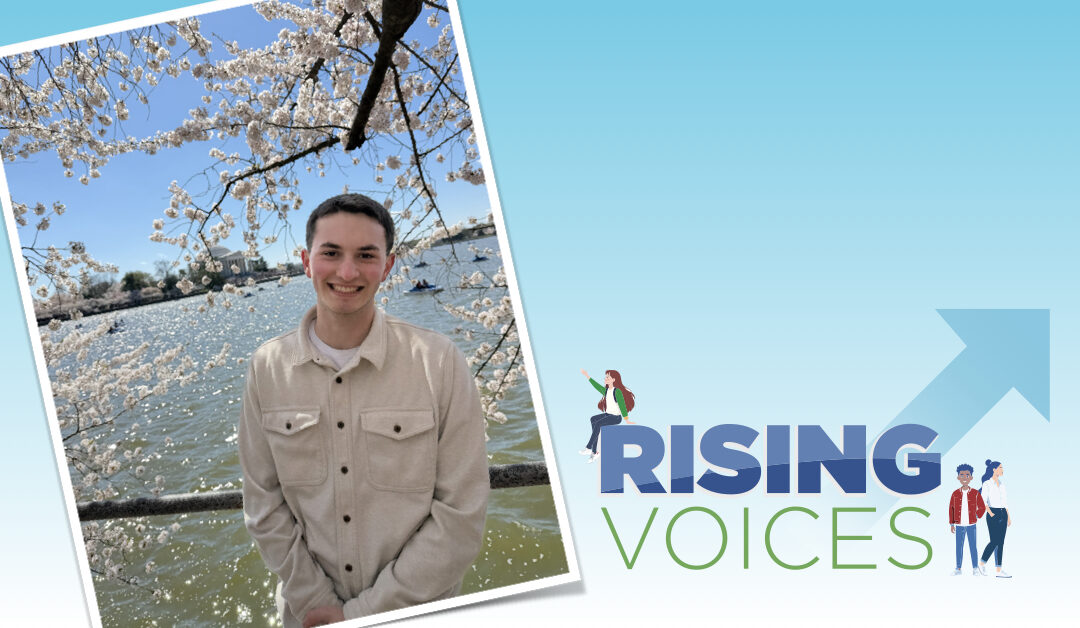
Calvin Plante & Finding his purpose
Calvin Plante wanted to make a difference. EdRising showed him how he could achieve that goal as a teacher.
It was the fall of 2020.
Calvin Plante was starting his freshman year of high school amid the COVID-19 pandemic. His cross-country season had just been canceled. Looking for something to fill his time, Plante joined his school’s Educators Rising chapter.
He immediately felt welcomed by the club’s enthusiastic co-presidents. Moreover, Plante was inspired by an organization he saw making a positive impact on education during one of the profession’s most challenging times. The shift to online instruction necessitated by the pandemic had left students feeling disconnected, while teachers were disheartened to spend all day, every day, talking to Zoom rooms “with blank screens and names, rather than students’ faces,” Plante recalled.
To encourage students to stay engaged, the EdRising club at Plante’s school — Pinkerton Academy in Derry, New Hampshire — sponsored a camera contest. Students who turned on their webcams for class were entered into a raffle.
“Classes became more interesting because more students were participating rather than just sitting behind their computers,” said Plante, now a sophomore at American University in Washington, D.C. “It was like a breath of fresh air — for both the teachers and the students. Everyone was engaging with what was being taught. Seeing the impact that EdRising had in that moment made me realize how much I wanted to be involved.”
Plante went all in. He took every teacher prep course he could and gained real-life experience while still in high school as an assistant teacher in elementary education, aerospace, dance, and theater. Plante attended EdRising state and national conferences, often competing or presenting. He went on to hold EdRising leadership positions at the club, state, and national levels, and in August accepted a part-time position with the national organization. His duties include helping manage the Educators Rising Ambassador Program, which elevates the voices of aspiring teachers from across the country.
The position gives Plante, who is double majoring in secondary education and American studies, the opportunity to stay connected to an organization that played a transformational role in his life. “Without Educators Rising, I wouldn’t have known that I wanted to be a teacher,” Plante said. Moreover, the connections he has made with other aspiring educators make him excited for the future. Critical thinking and self-reflection are crucial parts of the classroom experience today, noted Plante.
The new focus shows the profession’s commitment to encouraging deeper, more personalized learning at every level, Plante explained. And, as a bonus, it means that today’s future educators will enter the profession with the benefit of having already practiced those skills as students.
“It is so important to be able to reflect and turn inward to consider what can I do better for my students, for my classroom,” said Plante, who would like to teach in a high school. “That’s a huge skill to be able to carry with you, and eventually, I think it’s going to be game-changing for our generation of educators.”
What I’ve Learned from EdRising
American University sophomore Calvin Plante joinedEdRising as a first-year high school student.
His time with the organization helped him realize:
- “Every single day, students are gleaning so much information from you as a teacher. Not just what you are actually teaching — but also life skills and lessons about how they want to approach the world and how they view the world.”
- “There are so many options when it comes to teaching — traditional classroom teacher, paraeducator, school counselor, speech-language pathologist, education administration. If you look closely, there’s bound to be something that you like.”
- “With Educators Rising, like so many things in life, what you put into it is what you get out of it. Go to the national conference, go to all your state conferences, show up at every meeting. You will learn so much and meet so many amazing people.”

PO Box 13090
Arlington, VA 22219
(812) 339-1156 (10am-4pm ET)
info@educatorsrising.org
media@pdkintl.org
Payment Remit Address:
P.O. Box 745955
Atlanta, GA 30374-5955
© 2026 Educators Rising. All Rights Reserved. | Privacy Policy
All pricing subject to change, our current price is what is reflected on the website.