
Americans Present an Education Agenda for the Next President in the 56th Annual PDK Poll
ARLINGTON, Virginia, August 21, 2024—The 56th PDK Poll of the Public’s Attitudes Toward Public Schools finds that Americans’ top educational priorities include the preparation of students to enter the workforce (84%) and the attraction and retention of good teachers in public schools (81%). Other top priorities include an increased focus on student mental health (73%), helping students who have fallen behind academically (72%) and college affordability (70%).
Two other priorities attract smaller majority support for increased federal attention: protecting students from discrimination (58%) and the availability of public pre-kindergarten programs (56%, rising to 67% among public school parents). Just thirty-five percent call for an increased focus on the expansion of charter schools.
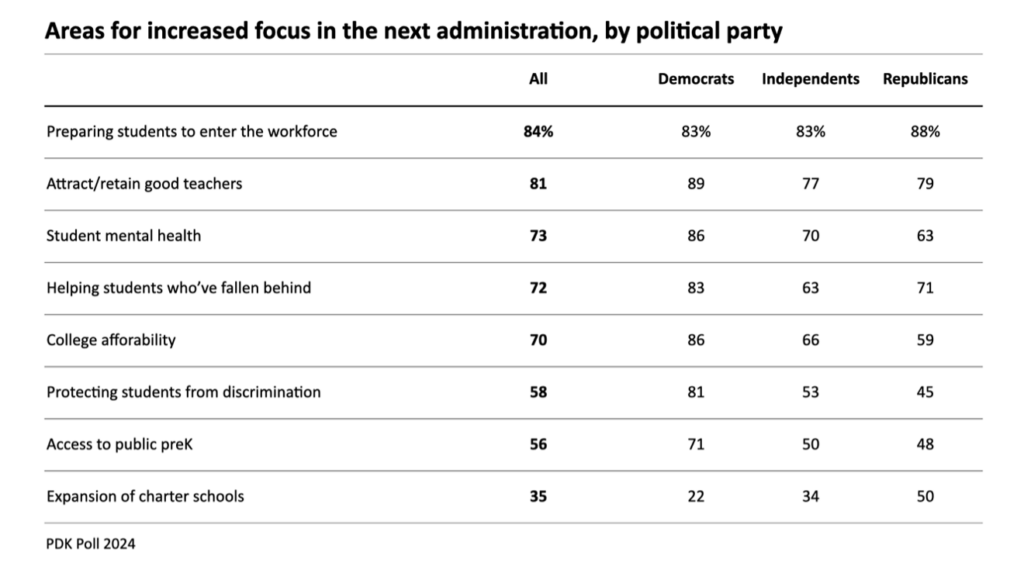
“Public support for quality educational outcomes for students that lead to employment, coupled with support for having quality teachers in every classroom, are priorities that candidates from either party in our upcoming election should know are supported by the American public,” said Dr. James Lane, chief executive of PDK International. “It’s refreshing to recognize that both the general public and public school parents recognize the need for communities to attract and retain the best for strong educational outcomes.”
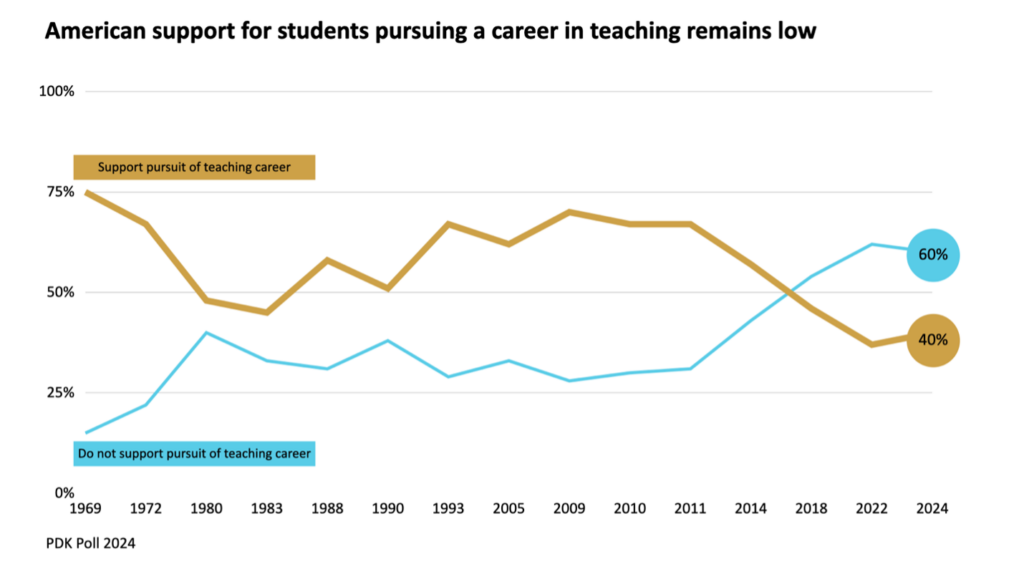
60% of Americans do not support their children pursuing a career in teaching
The 56th PDK Poll repeated questions from past polls to gauge support for students choosing a teaching career. Sixty percent of Americans would not support their child to take up teaching in the public schools as a career. That is consistent with results from a similar question asked on the 2022 PDK Poll—yet far from the seventy-five percent of Americans who supported their child becoming a teacher when the question first was asked in 1969. Among the six in ten who would not want their child to teach in the public schools, most cite inadequate pay and benefits (33%) or a lack of student discipline (27%) as the primary reasons why. The rest split between saying the job of a teacher is thankless (17%), that they’re concerned about school safety (13%) or that the job is too demanding (9%).
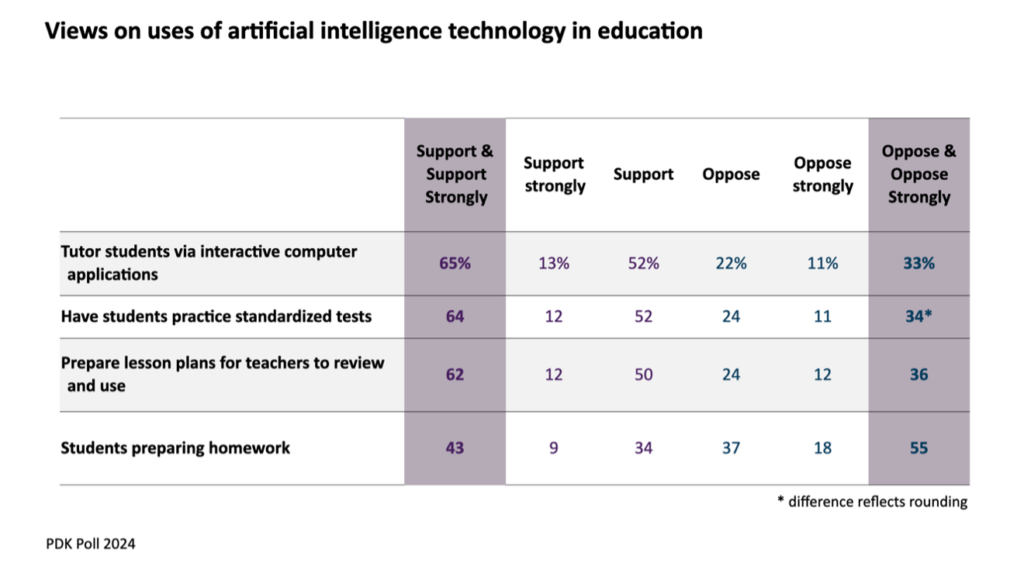
Many Americans support use of AI in certain educational applications
Another topic addressed in this year’s poll was the use of artificial intelligence in schools. More than sixty percent of Americans support the use of AI to prepare lesson plans for teachers’ review and use, to tutor students via interactive computer applications and to have students practice taking standardized tests. There was far less support for using AI to help students prepare homework (43%).
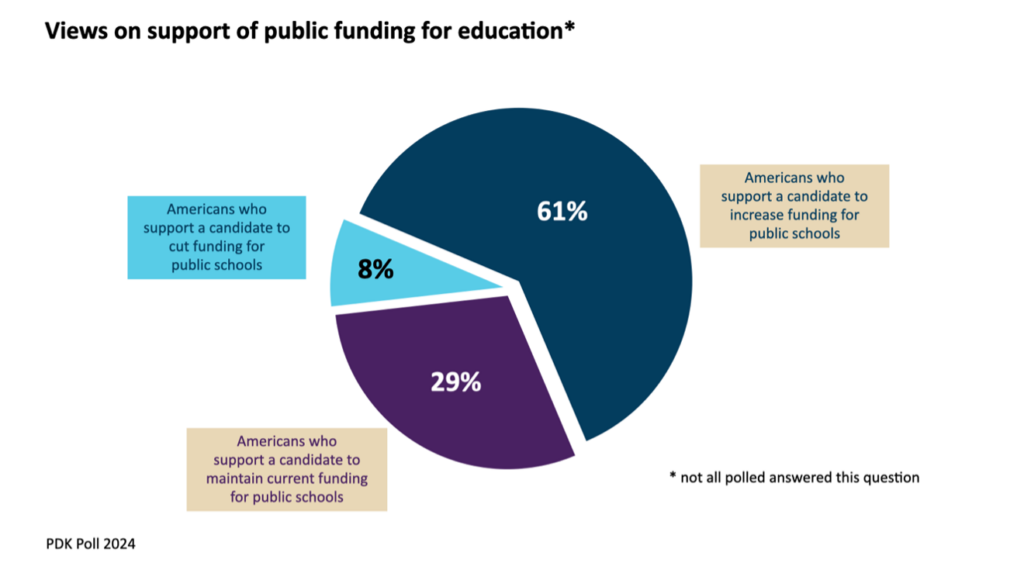
More than half of Americans support a candidate who will increase funding for public schools
In terms of the upcoming election, sixty-one percent of Americans prefer a candidate for office who supports increased public school funding. This peaks at eighty-two percent among liberals, seventy-nine percent among Democrats and roughly seven in ten among Black Americans, Hispanic Americans and public school parents. It’s lowest among conservatives (40%), Republicans (47%) and rural residents (51%).
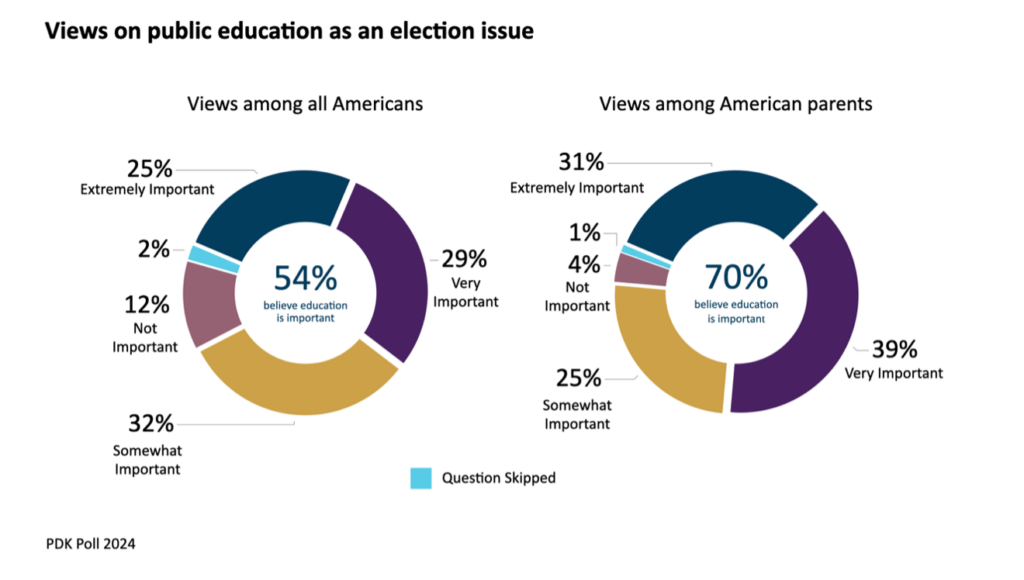
Public education is a significant election issue for many Americans, especially for public school parents. Fifty-four percent overall say the issue of public education will be extremely (25%) or very (29%) important in their vote for president; that rises to seventy percent among public school parents, including thirty-one percent who say it’s extremely important.
Political divide reflected in support of major-party candidates
This year’s poll also asked Americans how President Biden was handling education policy. PDK included the same question in our 2020 poll about then President Trump. Forty-five percent of Americans approve of how Biden is handling education policy, while fifty percent disapprove. This closely approximates attitudes about Donald Trump’s performance on education policy in the 2020 PDK Poll, forty-five percent approving versus fifty-three percent disapproving. At the time the poll was conducted, prior to President Biden dropping out of the race, Biden had a slight lead over Trump, thirty-six versus thirty-one percent, in trust to handle education, with twenty-five percent not trusting either candidate.
The 2024 PDK Poll was produced by Langer Research Associates with data collected June 21 through July 1, 2024, in English and Spanish, among a representative, random national sample of 1,009 adults. Polling data was collected both before and after the June debate between President Biden and former President Trump, and before President Biden chose to not seek re-election.
To read the full report of the 56th Annual Poll of the Public’s Attitudes Toward Public Schools, visit www.pdkpoll.org.
Interviews
To request an interview with Dr. James Lane contact Millie Hernandez at mhernandez@pdkintl.org. Lane serves as chief executive for PDK International and has extensive experience in federal, state, and local leadership and education policy. For more information about Dr. Lane, access a biography on our website.
###
About PDK International
Established in 1906, PDK International supports P-20 educators, researchers, and policy makers by strengthening their commitment to the profession throughout the entire arc of their careers. We are committed to elevating the profession through the intersection of research and practice. Through our core values of community, leadership, service, optimism, and excellence, we encourage educators and stakeholders to elevate the discourse and change the narrative around teaching and learning to ensure that every student has a high-quality education. https://www.pdkintl.org
About Educators Rising
In 2015, PDK International – in its 115-year commitment to the profession of education – launched Educators Rising, formerly the Future Educators Association (FEA). Today, Educators Rising is cultivating a new generation of highly skilled educators by guiding young people on a path from high school through college and into their teaching careers. By working with aspiring educators who reflect the demographics of their communities and who are passionate about serving those communities through public education, Educators Rising is changing the face of teaching. https://educatorsrising.org/

PO Box 13090
Arlington, VA 22219
(812) 339-1156 (10am-4pm ET)
info@educatorsrising.org
media@pdkintl.org
Payment Remit Address:
P.O. Box 745955
Atlanta, GA 30374-5955
© 2026 Educators Rising. All Rights Reserved. | Privacy Policy
All pricing subject to change, our current price is what is reflected on the website.