When we say “education career,” most people picture a classroom teacher. And teaching is a remarkable career — one where a single professional can impact over 3,000 lives and boost a classroom’s cumulative lifetime earnings by $250,000.
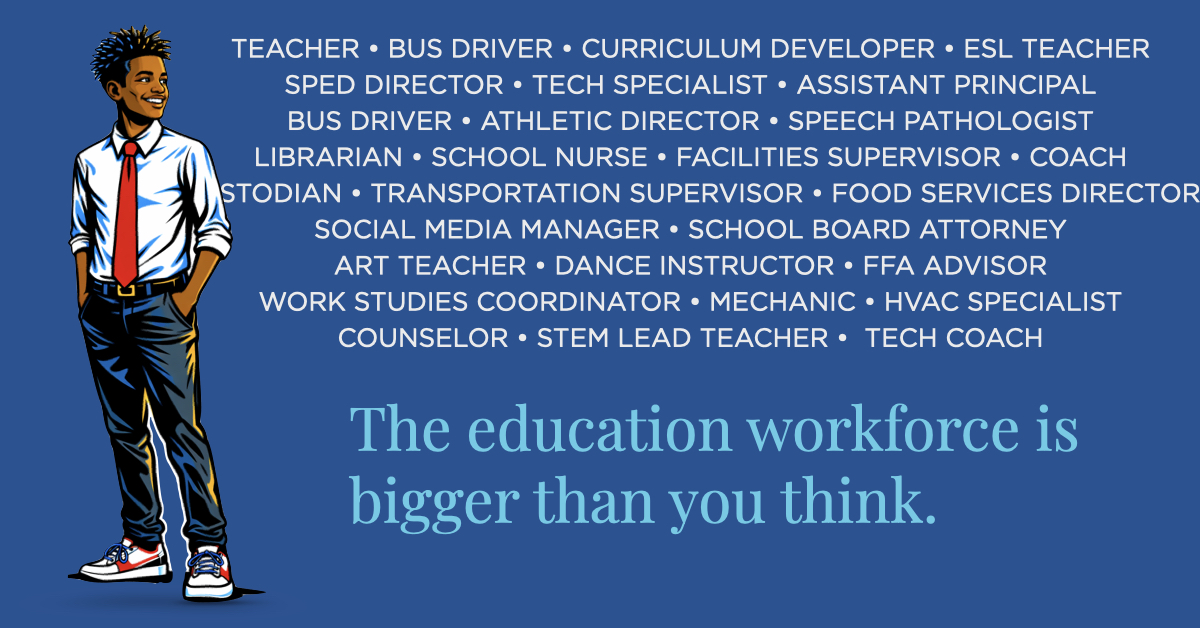
But here’s what most students never hear: teachers make up only about 40% of the K-12 workforce.
The other 60% — the people who design curriculum, manage school technology, analyze student data, counsel families, shape education policy, plan facilities, lead communications, coordinate transportation, develop training programs, and dozens of other critical functions — are just as essential to making schools work. And K-12 schools alone employ over 8 million people, making public education one of the largest employment sectors in the country.
All of public education benefits when we have dreamers, leaders, and those who genuinely care for children coming forward. We have an opportunity to give them an experience to try and teach. But to also know that if their talents lay elsewhere, there are still options for helping to improve the future of our education system.
More careers than most students can name
The breadth of education-related careers surprises even veteran educators. Beyond classroom teaching, students can explore paths in areas like:
- Instruction and learning design — curriculum designers, instructional coaches, reading specialists, ESL specialists, early childhood educators, gifted and talented coordinators, and career and technical education instructors.
- Student support — school counselors, school psychologists, social workers, behavioral interventionists, college and career advisors, and student success coaches.
- Technology and innovation — instructional technologists, ed-tech developers, learning experience designers, LMS administrators, data analysts, assistive technology specialists, and AI-in-education specialists.
- Leadership and administration — principals, assistant principals, superintendents, deans, department chairs, and district-level directors across curriculum, operations, and human resources.
- Communications, policy, and advocacy — education marketing strategists, communications directors, policy analysts, grant writers, education journalists, and nonprofit program directors.
- Research and assessment — education researchers, assessment designers, program evaluators, and psychometricians.
- Facilities, operations, and beyond — school architects, safety directors, food services directors, transportation coordinators, and facilities managers.
And that’s just K-12. The broader education sector — spanning higher education, corporate training, workforce development, and ed-tech — employs approximately 13 million people nationally and is projected to reach nearly 14.5 million by 2026.
This isn’t a niche career sector. It’s one of the largest in the country. And right now, most students graduate without ever learning that.
Why early exposure matters
Introducing students to the full landscape of education careers isn’t just about broadening their options — it builds real capacity.
Students who explore education-related pathways develop competencies that transfer across virtually any career: communication, instructional thinking, empathy, leadership, project management, and the ability to design experiences for other people. These aren’t soft skills. They’re foundational capabilities that employers across every sector are actively seeking.
And the timing matters. 86% of high school students say gaining career-relevant skills is their top employment goal. 89% of Gen Z say a sense of purpose is essential to their job satisfaction. Student interest in purpose-driven careers is surging — and education is one of the most purpose-rich fields in existence.
When students encounter these careers early — in high school, through a structured program — they don’t just learn about education. They start developing the mindset and skills of someone who can contribute to it. Whether they ultimately become a teacher, a school counselor, an instructional designer, or a policy analyst, that early foundation shapes how they show up.
For districts, this is also a pipeline conversation. Every student who discovers education as a career while still in your building is a potential future colleague — someone rooted in your community, familiar with your students, and already invested in your mission. It’s grow-your-own at the source, and it’s far more cost-effective than recruiting from the outside and absorbing the high turnover costs that come with teachers who have no connection to the community they serve.
Starting a program is easier than you think
Educators Rising offers a structured, curriculum-backed program that introduces students to the full range of education careers — not just classroom teaching. Our courses are designed to fit within existing CTE pathways and can run under a variety of course titles, including Education Professions, Teaching Academy, Future Educators, and others that align with your school’s or district’s programming.
But you don’t have to figure it out alone.
Our outreach coordinators work directly with teachers and district leaders to help you evaluate fit, navigate logistics, and build support within your school or district. Whether you’re a teacher with an idea or a CTE director looking for a new pathway, they can meet you where you are.
Our Grow Your Own Playbook provides a step-by-step framework for districts building educator pipelines — from early awareness in high school through postsecondary partnerships and into the profession.
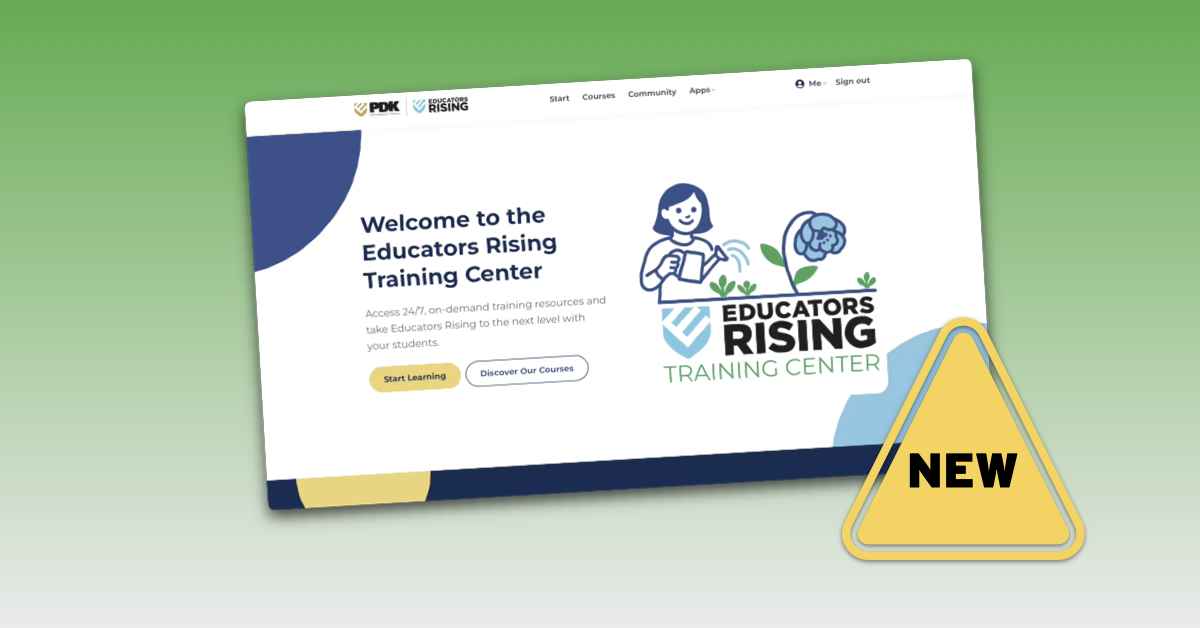
Our new online training platform — launching this spring — gives chapter advisors the preparation and ongoing support they need to lead the program confidently, even if they’ve never done anything like it before.
Every Educators Rising chapter starts with one person who decides it matters. If you’re reading this and thinking it might be you — or someone in your building — we’d like to help you take the next step.