Some of us love to share our ideas in small groups and, without prompting, naturally assume a leadership role. Others participate through listening, notetaking, or researching and collecting materials.
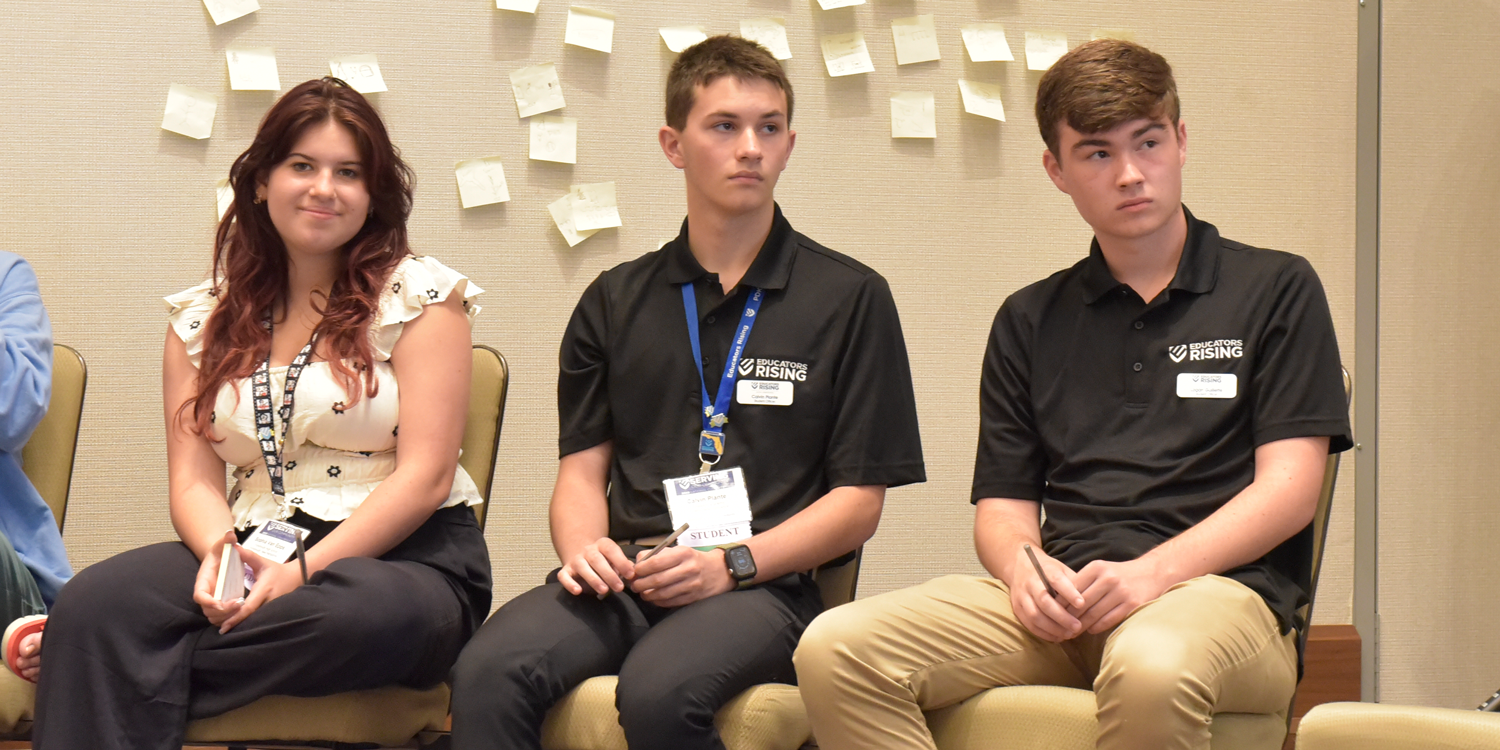
Miriam Morgenstern’s Saturday breakout session was on teaching a lesson topic from the Educators Rising Curriculum on small-group instruction. She asked attendees to consider which role they gravitate toward in small groups. Morgenstern, the Massachusetts state and regional coordinator for Educators Rising, then divided the groups up homogeneously for the rest of the presentation.
In these small groups, participants discussed the advantages and challenges of small-group instruction using the Educators Rising curriculum PowerPoint lesson slides as a guide. The slide deck is fully customizable depending on the needs of the instructor and students. For example, one of the participants suggested expanding the lesson objectives to include higher-order thinking skills that would encourage rising educators to create their own small-group protocols. Another offered a strategy of using a jigsaw activity as a formative assessment, so the instructor could tailor the rest of the lesson to better serve students.
Teachers use small-group work when instructional goals call for in-depth interaction among students and to teach students to work collaboratively. To use groups effectively, teachers choose tasks that require and foster collaborative work, issue clear directions, and implement mechanisms for holding students accountable.
Participants in this session left with a clearer understanding of small group instruction and implementation of the Educators Rising curriculum.

PO Box 13090
Arlington, VA 22219
(812) 339-1156 (10am-4pm ET)
info@educatorsrising.org
media@pdkintl.org
Payment Remit Address:
P.O. Box 745955
Atlanta, GA 30374-5955
© 2026 Educators Rising. All Rights Reserved. | Privacy Policy
All pricing subject to change, our current price is what is reflected on the website.