
Our Voices
John the Educators Rising Rapid Response Survey team
Do you want your voice heard on the most significant issues in education? Becoming a Rapid Response Survey team member is an incredible way to share your student voice. It’s easy! Sign up online, and we’ll text you when a new survey is ready. Each survey takes just a few minutes, but your responses can make a real impact on educational policy. As a reward, each team member gets a $5 discount code for the Educators Rising Store, valid for one month.
Don’t miss this chance to be part of something bigger. Let’s reach our goal of 500 participants together! Sign up using an online application form.
Rising, Rising Voices
Educators Rising this year is launching Rising Voices, an online blog that is written expressly for our students and teacher leaders. In addition to content provided by our Kappan team, we look forward to publishing shortform content from students and teacher leaders that highlights what’s happening in your communities. Whether you like to express yourself through the written word, or video, or through visual art, we are currently accepting content.
If you’re thinking of contributing, we invite you to join our RisingVoices mailing list to get updates and to learn more about how to contribute.
Where do you fit in? Educators Rising can help you decide.
Students often tell us that they joined their school’s Educators Rising chapter because they were invited. A friend or a classmate may have said, “Hey, this group has a lot of fun.” It could be that a teacher suggested the chapter would be a good fit.
Some students join Educators Rising because they’re very interested in becoming a classroom teacher.
If you’ve always wanted to be a teacher, you accepted the invitation and now you’re an active part of your chapter. However, you might be interested in education, but you don’t think being a classroom teacher is the right career for you. You also could find your place with Educators Rising.
Look at all the adults in your school and district who aren’t teachers. They were drawn to a career in education too, but in different ways.
It’s true: not all educators are teachers.
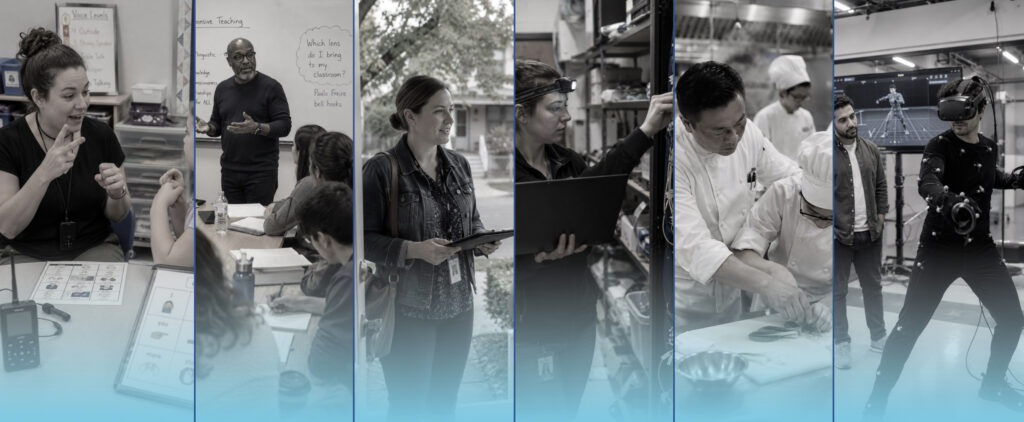
There’s the person who unlocked the front door in the morning before anyone else arrived. The one who got the projector working in your third period science class. The one who plated lunch for hundreds of students before you’d finished second block. The one who ran practice until the field lights came on.
Your band director rehearses a hundred people at once and knows how each of them sounds. Your welding instructor spent years in the trade before they ever stood in front of a class. Your culinary teacher ran real kitchens. Your dance teacher trained for a decade to perfect her choreography skills. These specialists got extremely good at a skill or a subject first and then decided they wanted to show others how to do it.
There are adults running your school in roles you may not have considered.
For many of your classmates, the school day includes adults you may never have met: A speech-language pathologist working on communication. An occupational therapist figuring out how to make a task physically possible. A reading specialist with a stack of diagnostic data. A school psychologist. A social worker who does home visits. A teacher of the deaf and hard of hearing who makes sure language is fully accessible in every room.
Every one of those roles required graduate school, clinical hours, and a license. The people in those roles chose to do that work in a school building instead of a hospital or a private clinic — because that’s where the students are.
Schools require people with technical skills, too. Your school runs on Wi-Fi that reaches every corner of a building made of concrete and steel. Thousands of devices. Filtering, backups, patching, and a student information system holding every record you’ve ever generated.
Somebody built your network. Somebody is standing in a wiring closet with a headlamp right now, tracing a cable because the third-floor access point dropped and 40 people can’t take a test.
The person who keeps your laptop clean and your network up is not incidental to your education. On the day it breaks, they are the most important person in the building.
If you’ve used a VR headset at school — walked through a heart, stood on Mars, practiced a procedure you couldn’t practice for real — several people had a hand in that experience. Someone decided what you were supposed to learn from it. Someone modeled the environment. Someone wrote the code. Someone tested it on students your age and watched them get confused in exactly the same spot and then went back and fixed it.
Educational game developers. XR learning designers. Instructional designers. They have to understand how learning works and how to build software. That combination is rare, and it pays like it.
Who teaches the teachers?
Still other roles to consider: Your teachers attended college to learn about instruction and pedagogy. Someone designed those courses. Someone sat in the back of their student teaching placement with a clipboard and told them what was and wasn’t working. Someone wrote the education textbook. Someone ran the study that changed how your district teaches reading.
There is an entire profession built around making teachers better: professors, mentors, instructional coaches, researchers. The math coach in your building isn’t teaching math to students. She’s teaching math teachers how to improve their instruction. Same job, one layer up.
Teaching, of course, is the heart and center of education. Nearly every role on this list is held by someone who taught first, or works alongside teachers daily, or exists specifically to make teaching work better. The principal was a teacher. The curriculum director was a teacher. The instructional coach still is one. However, the education field is wider than the job you can see from your classroom and includes many roles.
You may want to work with kids but dislike the idea of grading. You may like to build things. You may be good at technical things nobody else understands. You can want a chef’s knife in your hand or a wrench or a laptop or a cello. There is a version of education that will serve to provide you a career.
Ask yourself where you would fit. If you joined Educators Rising because you knew you wanted to become a teacher, you’re in the right place. But there are other education careers that you and your friends can explore as part of Educators Rising too.

PO Box 13090
Arlington, VA 22219
(812) 339-1156 (10am-4pm ET)
info@educatorsrising.org
media@pdkintl.org
Payment Remit Address:
P.O. Box 745955
Atlanta, GA 30374-5955
© 2026 Educators Rising. All Rights Reserved. | Privacy Policy
All pricing subject to change, our current price is what is reflected on the website.